
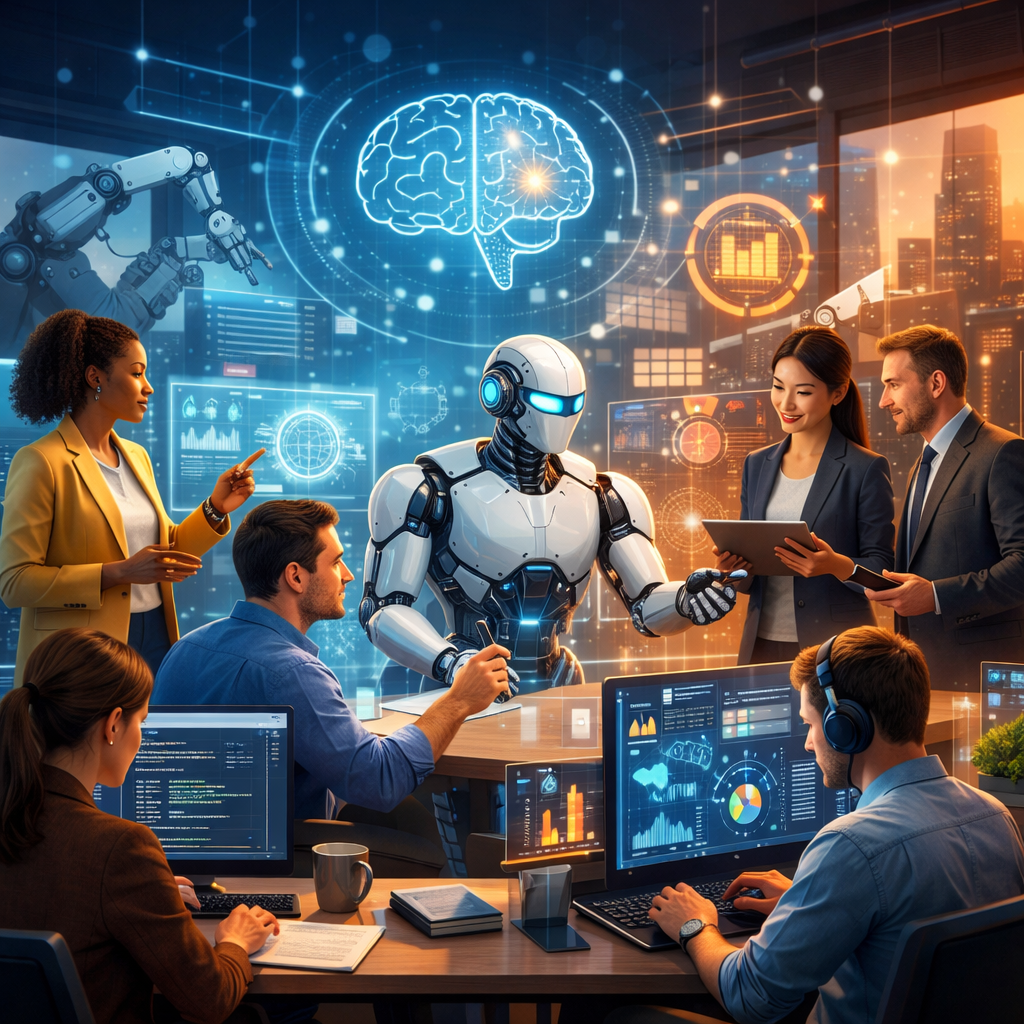
Introduction: The Workforce Is Not Being Replaced, It Is Being Rewritten
What if the biggest workforce disruption of the next decade isn’t job loss… but job redesign?
Across industries, executives are confronting a new reality: Artificial Intelligence is rapidly reshaping how work gets done.
AI copilots are drafting documents, analyzing data, coding software, assisting customer interactions, and supporting decision-making. Within the next few years, analysts predict that more than half of employees will work alongside AI agents embedded into everyday workflows. But here’s the critical insight many organizations are only beginning to understand:
· AI is not replacing people.
· It is redefining work itself.
· Tasks are changing.
· Roles are evolving.
· Entire workflows are being redesigned.
The organizations that will thrive in this new era are not those that simply adopt AI tools, but those that reimagine how humans and intelligent systems work together. This is the moment when workforce strategy becomes one of the most important leadership priorities of our time.
The Shift From Jobs to Work Design
Historically, organizations structured work around fixed job descriptions. A role was defined by a set of responsibilities, tasks, and skills. Employees executed those tasks, managers supervised them, and organizations optimized around productivity. AI changes that equation.
Today we are entering a new operating model where work is organized around capabilities instead of static roles.
Instead of asking:
“What tasks should this employee perform?”
Forward-thinking organizations are asking:
“Which tasks should be automated, which should be augmented by AI, and which require uniquely human capabilities?”
This shift is creating three new categories of work:
1. Automated Work
Routine tasks that AI systems can perform faster and more accurately.
Examples include:
- Data processing
- Routine coding
- Document summarization
- Customer interaction triage
2. AI-Augmented Work
Tasks where AI copilots significantly enhance human productivity.
Examples include:
- Software development
- Marketing content creation
- Financial analysis
- Customer support
3. Human-Skilled Work
Areas where uniquely human capabilities remain irreplaceable.
These include:
- Leadership and decision-making
- Creativity and innovation
- Complex problem solving
- Relationship building and trust
The organizations that win will not be those that eliminate jobs, but those that intelligently redesign them.
The Rise of the “AI-Ready Workforce”
Adopting AI technology is the easy part. Building an AI-ready workforce is the real challenge.
An AI-ready workforce requires three foundational capabilities:
1. AI Literacy Across the Organization
Employees must understand:
- How AI tools work
- Where they add value
- Their limitations and risks
AI literacy will become as fundamental as digital literacy.
2. Continuous Skills Development
As work evolves, skills must evolve with it.
Organizations must invest in:
- Reskilling programs
- Learning ecosystems
- real-time skills development
The half-life of skills is shrinking rapidly, meaning workforce development must be continuous, not episodic.
3. Human-centric and Ethical AI Governance
AI introduces complex questions around:
- data privacy focused
- Human skills empowered
- Transparency heightened
- Accountability driven
Organizations must establish governance frameworks that ensure AI enhances human capability rather than undermining trust.
Why Workforce Transformation Is Now a Leadership Imperative
The AI transformation is not just a technology challenge.
It is fundamentally a leadership challenge. Leaders must answer critical questions:
- Which roles will evolve, and how?
- What skills will the future workforce require?
- How do we prepare employees to work effectively with AI?
- How do we redesign workflows without disrupting productivity?
Organizations that fail to address these questions risk falling behind. Those who succeed will unlock extraordinary gains in:
- productivity
- innovation
- employee engagement
- organizational agility
This is where workforce strategy becomes a competitive advantage.
How Thrivin Helps Organizations Build an AI-Ready Workforce
At Thrivin, we believe the future of work belongs to organizations that invest in people as intentionally as they invest in technology. AI may transform work, but human capability remains the ultimate driver of success.
Thrivin helps organizations navigate workforce transformation by focusing on three critical areas:
Talent Strategy
Helping organizations identify the talent and skills needed for the future.
Skills Intelligence
Understanding emerging skills gaps and building targeted upskilling pathways.
Workforce Transformation
Designing workforce strategies that align talent, technology, and organizational goals.
Discover how: https://www.getthrivin.com
Five Actions Leaders Should Take Now
Organizations that want to thrive in the AI era should begin taking these steps today.
1. Redesign Workflows — Not Just Jobs
Analyze tasks across roles and determine which should be automated, augmented, or human-led.
2. Invest in AI Literacy and Human Skills
Ensure employees understand how AI tools function and how to work effectively with them using there newly empowered human-centric skills to perform at more effective levels.
3. Build a Skills-First Workforce Strategy
Shift from degree-based hiring toward capability-based talent development.
4. Create Continuous Upskilling Systems
Learning and application must become part of the daily workflow, not occasional training.
5. Establish Responsible AI Governance
Ensure AI adoption is aligned with ethical standards, human skills, and organizational values.
A Vision for the Future of Work
Imagine a workforce where:
- AI handles routine tasks
- Humans focus on creativity, strategic thinking and the many human-centric skills needed everyday.
- Skills evolve continuously, so learning and application happens daily in the flow of work.
- Organizations adapt faster, more effectively and more efficiently than ever before.
This is not a distant future. It is emerging right now. The organizations that will lead the next decade are those that recognize a simple truth:
AI does not diminish the value of people, it amplifies it. But only if organizations design work intentionally.
Next Steps
The future of work is being written today. Thrivin is helping organizations around the world prepare their workforce for what comes next. Here’s how you can get started:
Follow Thrivin on social media
Stay informed on the latest workforce and talent insights.
Explore our resources
Visit:
https://www.getthrivin.com
Start a conversation
Contact Thrivin today to discuss how we can help your organization build an AI-ready & Human skills empowered workforce. Together, we can transform workforce challenges into opportunities for growth, innovation, and lasting impact.